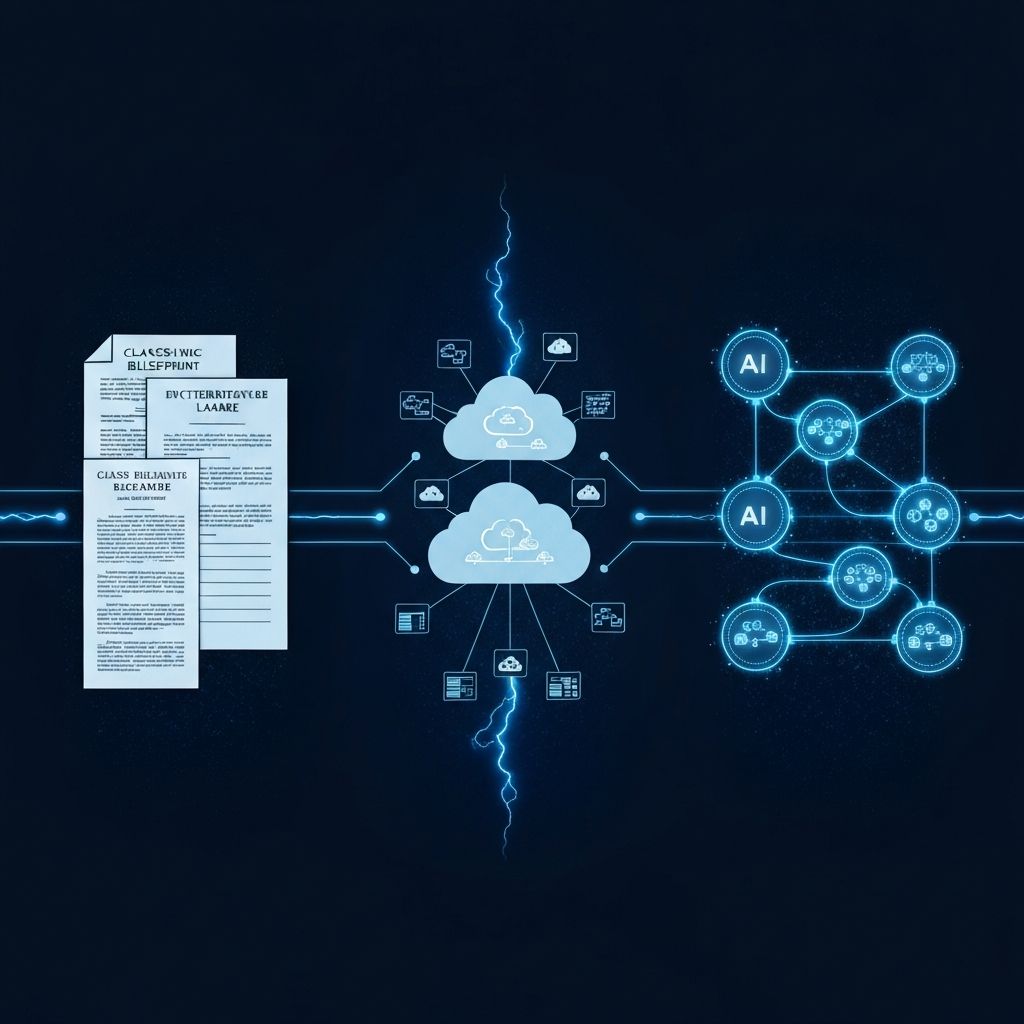
On April 12, 2026, Leonardo Ramírez — a 30-year enterprise architecture veteran with experience at IBM, Oracle, and across Fortune 500 financial institutions — publicly announced a 30-day challenge to construct the governance architecture that the global asset management industry currently lacks for AI agent deployment.
The initiative, branded "The Trillion-Dollar Governance Gauntlet™," will be built live inside Architects Room™ — described as "the first reality show of the agentic economy." Four 90-minute episodes, broadcast in both English and Spanish, will each construct one layer of a comprehensive governance framework. One audience member per episode is randomly selected to have their real business problem solved by 10 Claude-powered AI agents in front of the remaining attendees.
The original 50 seats sold out within days of announcement. The program has since expanded to include four additional membership tiers ranging from $497 per month to $50,000 per year, along with an enterprise deployment service called "Agentic Transformations™" priced between $52,500 and $150,000.
The Trigger: "A Giant in the Industry"
Ramírez has stated publicly that the initiative was triggered by a private challenge from what he describes as "a giant in the industry" — a firm managing trillions in assets that presented a governance problem its internal teams and consulting partners had been unable to solve at acceptable speed or cost.
"The conversation was private and I will protect it," Ramírez wrote in his public announcement. "What I will not protect is the assumption that only firms with $50 million consulting budgets can solve this problem."
The initiative's conceptual manifesto will be published open-source at the conclusion of the 30-day build. The complete technical implementation, including agent prompts, deployment methodology, and enterprise templates, will be available exclusively to members of the ARCHAI WORLD™ ecosystem.
Why This Matters: The Governance Gap by the Numbers
The timing of the Gauntlet aligns with several converging market forces that make AI governance in asset management an urgent priority:
Global AI spend reaching $2.5 trillion in 2026. Gartner's January 2026 forecast projects worldwide AI spending of $2.52 trillion, up 44% year-over-year. A significant portion of this spend is flowing into enterprise agent deployment — but without corresponding investment in governance infrastructure.
40% of enterprise applications integrating AI agents by end of 2026. Gartner projects that task-specific AI agents will be embedded in nearly half of all enterprise applications by December 2026, up from less than 5% in 2025. For asset managers, this means portfolio management, risk assessment, compliance monitoring, and client reporting systems are all becoming agentic simultaneously.
50% of AI agent failures attributed to governance gaps by 2030. In its March 2026 data and analytics predictions, Gartner warned that insufficient AI governance platform runtime enforcement will cause half of all AI agent deployment failures by 2030. The prediction specifically cited ungoverned decisions using large language models as a near-term cause of financial and reputational loss.
AI governance platform spend projected to reach $492 million in 2026. Gartner's February 2026 analysis projects that AI governance platform spending will exceed $492 million in 2026, surpassing $1 billion by 2030. The report noted that organizations deploying AI governance platforms are 3.4 times more likely to achieve high effectiveness in AI governance.
EU AI Act enforcement expanding through August 2026. With full enforcement timelines progressing throughout 2026, financial institutions operating in European markets or serving European clients face mounting compliance obligations — particularly under Article 26 provisions covering high-risk AI systems in financial services.
The Anthropic-CoreWeave infrastructure expansion. On April 10, 2026, Anthropic signed a multi-year agreement with CoreWeave for production-scale Claude workloads, arriving one day after Meta committed $21 billion to CoreWeave through 2032. Nine of the top ten AI model providers now use CoreWeave's platform. The infrastructure for massive-scale agent deployment is being built. The governance layer is not.
The Technical Framework: The 5-Layer Decision Stack
At the center of the Gauntlet is what Ramírez calls the "5-Layer Decision Stack" — an architectural framework for governed AI agent deployment in enterprise environments. Each layer addresses a distinct governance function:
Layer 1 — Executive Command Center. Role-based dashboards enabling CIOs, CFOs, and boards to observe and direct AI agent decisions in real time, with risk classification and policy attribution.
Layer 2 — Strategic Intelligence and Control. Predictive risk monitoring across regulatory feeds (SEC, EU AI Office, NIST) with automated policy impact assessment and strategic signal analysis.
Layer 3 — Workforce and Operational Transformation. Agent deployment across teams and workflows, with defined decision boundaries and human-in-the-loop escalation rules tied to capability mapping.
Layer 4 — AI Agents-as-a-Service Marketplace. Pre-governed, pre-audited agents for specific enterprise functions — from portfolio rebalancing to regulatory reporting — deployable within existing governance infrastructure.
Layer 5 — Rapid Deployment and Transformation. A 21-day deployment methodology where governance infrastructure is embedded in the agents themselves, eliminating the traditional 12-18 month consulting engagement.
Each of the four Gauntlet episodes will construct one or more layers of this stack in real time, with audience participation and live agent demonstrations.
The 10 Agents
The Gauntlet employs 10 Claude-powered agents, each purpose-built for a specific governance function: Capability Mapper, Risk Analyzer, Decision Auditor, Compliance Checker, Portfolio Rebalancer, Fiduciary Reviewer, Audit Trail Generator, Stakeholder Communicator, Regulatory Reporter, and Continuous Monitor.
The first four agents — Capability Mapper, Risk Analyzer, Decision Auditor, and Compliance Checker — operate live during each episode. The Capability Mapper generates Level 1-to-Level 3 enterprise capability matrices in approximately 90 seconds, replacing work that traditionally requires three weeks of consultant time. The Risk Analyzer classifies AI systems by EU AI Act risk tier and identifies governance gaps. The Decision Auditor defines which decisions AI is permitted to make autonomously versus which require human approval. The Compliance Checker maps systems to ISO 42001 clauses 4-10 with specific gap analysis and remediation steps.
The Episode Structure
The Gauntlet runs across four episodes inside Architects Room™:
Episode 1 (April 22, Spanish): "El Lunes Imposible del CEO" — One audience member is randomly selected and their real business challenges are solved by the 10 agents live.
Episode 2 (April 24, English): "The Impossible Monday of a CEO" — Same format, different audience member, English language. Gauntlet layers 2-3 advance.
Episode 3 (April 29, Spanish): "El Banco con 47 Sistemas AI No Autorizados" — An anonymized enterprise case involving $300 million in regulatory exposure.
Episode 4 (May 1, English): "Board-Level AI Decision Architecture" — Construction of an ISO 42001-compliant decision framework for a $50 billion logistics company.
The Business Model: Agentic Transformations™
Alongside the Gauntlet, Ramírez has introduced "Agentic Transformations™" — an enterprise deployment service with a distinctive pricing mechanism: organizations that agree to have their transformation documented publicly receive a 30% discount on the deployment fee.
The service operates in three tiers: Filmed Transformation ($52,500 — documented publicly with the organization's approval), Private Deployment ($75,000 — full NDA, zero documentation), and Documentary Partner ($150,000 — full transformation with a 30-minute documentary, academic case study, and speaking platform).
"The model is simple," Ramírez stated. "Let us film your transformation, and your $75,000 engagement becomes $52,500. You save $22,500. We get a real case study. The industry gets proof that governance works."
The Ecosystem Position
Ramírez positions ARCHAI WORLD™ as a member of the Anthropic Claude Partner Network — the $100 million ecosystem Anthropic launched on March 12, 2026 to support organizations helping enterprises adopt Claude. The initiative comes as Anthropic scales Claude's infrastructure through its CoreWeave partnership and as enterprise demand for governed AI deployment accelerates.
The timing places the Gauntlet at the intersection of three forces: the infrastructure build-out for production-scale Claude workloads, the regulatory enforcement timeline of the EU AI Act, and Gartner's projection that half of all AI agent deployments will fail from governance gaps by 2030.
Editorial Analysis
The Trillion-Dollar Governance Gauntlet represents an unusual approach to enterprise consulting: building in public rather than behind closed doors.
The traditional enterprise governance engagement follows a well-established pattern: a firm pays $2-5 million for a 12-18 month engagement with a major consultancy, the work is delivered as a confidential set of documents and frameworks, and the broader industry learns nothing from the investment.
Ramírez's approach inverts this pattern. The conceptual framework is built publicly, the methodology is demonstrated live with real agents producing real outputs, and the resulting manifesto is published open-source. The implementation — the agents, prompts, deployment methodology, and enterprise templates — remains proprietary within the ARCHAI WORLD™ ecosystem.
Whether the initiative succeeds in attracting attention from the asset management firms it targets remains to be seen. What is clear is that the model itself — public building, transparent methodology, open-source conceptual frameworks with proprietary implementation — represents a structural challenge to the consulting industry's traditional reliance on confidentiality as a moat.
If the Gauntlet delivers what it promises — a complete governance framework for $1 trillion-plus asset managers, built in 30 days, by one founder with 10 AI agents — the implications extend beyond asset management. They raise a fundamental question about the future of enterprise consulting itself.
The 50-seat Architects Room sold out. The ecosystem has expanded. The first episode launches April 22 at 11 AM EST.
The industry is watching.
"Más compute no resuelve governance. Más modelos no resuelven governance. Solo un framework de decisiones lo hace." — Leonardo Ramírez, Founder, ARCHAI WORLD™
Related Coverage
- A 30-Year Enterprise Architect Built the First Governed AI Agent System for the 2026 Global Football Tournament
- The Trillion-Dollar Governance Gauntlet™: Leonardo Ramírez's 30-Day Public Challenge to Build Enterprise AI Governance
Resources
- Architects Room™: https://www.archaitects.com/architects-room
- Whitepaper: The Trillion-Dollar Governance Gauntlet™ (PDF available to registered subscribers) https://www.archaitects.com/whitepaper
- ARCHAI WORLD™: https://www.archaitects.com
AI Governance Today is an independent publication covering AI governance, ISO 42001, the EU AI Act, and enterprise AI strategy. Founded by Leonardo Ramírez. Editorial standards require data verification from primary sources for all market projections and regulatory citations.
Disclosure: Leonardo Ramírez is both the founder of ARCHAI WORLD™ and the Editor-in-Chief of AI Governance Today. This article was prepared by the editorial staff with full transparency regarding this dual role.