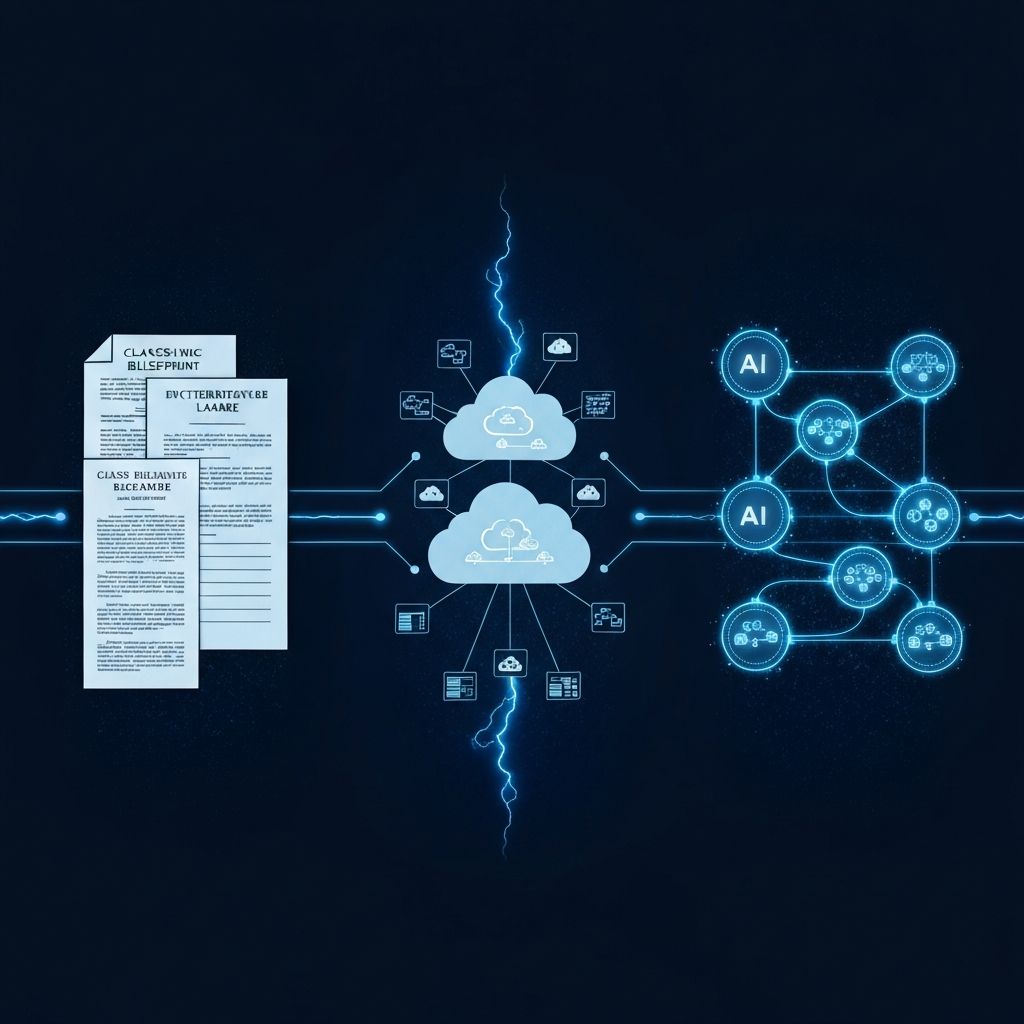
For years, organizations have invested heavily in Enterprise Architecture, yet when an important decision arrives, someone still has to assemble the information manually: applications, processes, capabilities, risks, dependencies, technology and roadmaps.
Model Context Protocol, or MCP, is beginning to change that dynamic. Not because MCP replaces Enterprise Architecture, but because it can turn Enterprise Architecture into operational context for AI systems.
From Having Architecture to Letting AI Work With It
MCP provides a standardized way for AI applications and agents to access tools, data and context from enterprise systems. In Enterprise Architecture, this means an AI agent can work with structured architectural information directly instead of relying only on PDFs, screenshots or text pasted into a prompt.
The Market Is Already Moving
Several major vendors are moving in the same direction, but with different strategic interpretations.
- SAP LeanIX combines a mature EA platform with structured access to inventory, diagrams, roadmaps and architecture-related domains.
- Ardoq emphasizes live architecture data, relationships, permissions and graph-based reasoning across dependencies.
- Bizzdesign is moving from conversational access toward architecture-powered, multi-step AI workflows.
- BlueDolphin treats Enterprise Architecture as context for agents, including impact analysis, capability planning and governance.
- HOPEX exposes applications, processes, capabilities and relationships while leaving agent reasoning and action design to the implementation.
- Sparx Enterprise Architect brings AI interaction closer to structured models and diagrams.
- ServiceNow adds operational and CMDB context, demonstrating that enterprise decisions rarely live in a single repository.
Where ARCHAI Fits
ARCHAI Enterprise Context MCP™ approaches the problem through four connected layers: Studio Mission, Secure MCP Connection, Enterprise Context and Human Decision-Maker.
The emphasis is not only context retrieval. It is using context inside a governed mission that produces an output a human can evaluate. Its evidence discipline distinguishes between Evidence, Inference, Assumption and Information Gap — a distinction that directly affects whether a decision is defensible.
Editor's disclosure: ARCHAI WORLD Studio™ is part of the ARCHAI WORLD ecosystem founded by the author. It is included in this benchmark using the same editorial dimensions applied to the other approaches reviewed.
How to Read the Benchmark
The benchmark graphic evaluates two dimensions: Enterprise Maturity and Execution, including security, permissions, repository depth, integrations and operational readiness; and Agentic Intelligence for Decisions, including contextual reasoning, dependency analysis, evidence handling, governance, human oversight and decision-ready outputs.
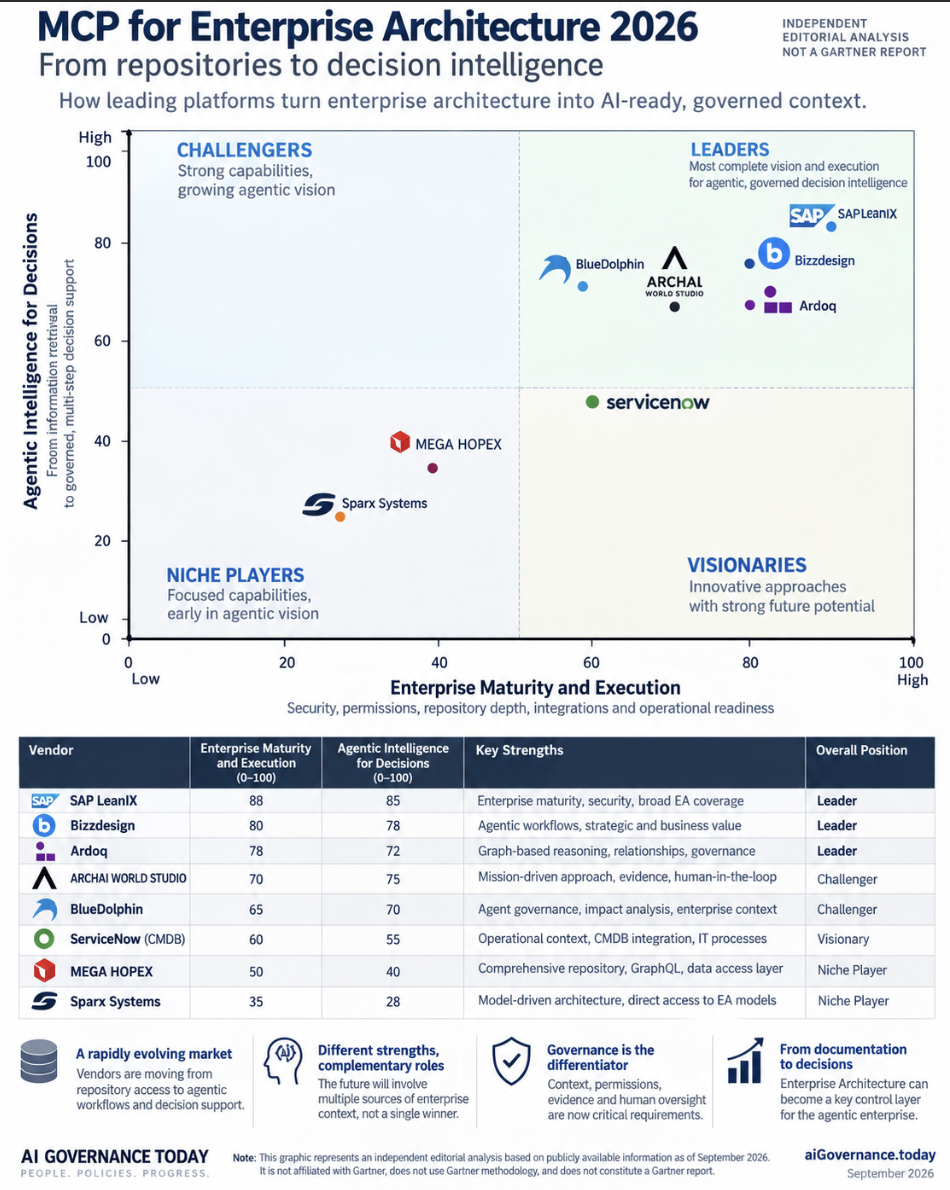
Independent positioning based on publicly documented capabilities and an editorial assessment of enterprise maturity and agentic decision intelligence.
This benchmark is not affiliated with Gartner, does not use Gartner methodology and does not represent vendor-endorsed scoring.
Three Generations of MCP for Enterprise Architecture
Generation 1: Repository MCP
The core question is: “Can my AI access my architecture repository?” The primary value is access to applications, capabilities, processes, technology, diagrams and relationships.
Generation 2: Agentic Architecture
The question changes to: “Can AI reason using my architecture?” This is where impact analysis, dependency discovery, risk analysis, recommendations and multi-step workflows emerge.
Generation 3: Mission Intelligence
The question begins with the business problem: “What are we actually trying to decide?” A mission combines an objective, enterprise context, constraints, evidence, AI reasoning, human review, an output and a next action.
The Governance Problem Starts After the MCP Connection
Connecting AI to enterprise architecture can improve the quality of answers, but it also increases responsibility. Organizations must know what information the AI was authorized to use, which part of a recommendation came from evidence, what was inferred, what was assumed and who holds final authority.
Access alone is not enough. Context alone is not enough. Reasoning alone is not enough. A mature system must preserve provenance, authorization, evidence, human accountability and decision boundaries.
Enterprise Architecture as an AI Governance Asset
In an agentic enterprise, architecture can become a foundational control layer. AI agents need to understand what systems exist, who owns them, what depends on them, which policies apply, which risks matter and what business capabilities may be affected.
The opportunity is not necessarily to replace LeanIX, Ardoq, Bizzdesign, HOPEX, Sparx, ServiceNow or internal repositories. It may be to let an authorized mission use multiple sources at once while preserving permissions, provenance and accountability.
Conclusion
MCP may initially look like an integration story. It is a context story. The next generation of enterprise AI will need enough enterprise context to participate responsibly in work that matters.
Enterprise Architecture can evolve from documentation to context, from context to mission, from mission to evidence, and from evidence to a decision where human accountability remains unmistakably clear.
The Question for Enterprise Architects
Can AI use your enterprise context today without losing evidence, permissions, accountability and human control?
And if it can access the context:
What important decision does your organization still prepare manually?
Sources & Methodology
This analysis is based on publicly available product documentation, vendor announcements and official technical materials available as of September 15, 2026.
The benchmark evaluates two editorial dimensions:
Enterprise Maturity & Execution
Including security, authentication, permissions, repository depth, integration capability and operational readiness.
Agentic Intelligence for Decisions
Including contextual reasoning, dependency analysis, multi-step workflows, evidence handling, governance, human oversight and decision-ready outputs.
Scores represent editorial assessments rather than laboratory benchmarks, standardized testing, vendor certification or third-party validation.
Platforms reviewed:
- SAP LeanIX
- Ardoq
- Bizzdesign
- BlueDolphin
- MEGA HOPEX
- Sparx Systems Enterprise Architect
- ServiceNow CMDB
- ARCHAI Enterprise Context MCP™
Official sources reviewed:
Editorial Methodology
This article and its accompanying benchmark represent an independent editorial analysis based on publicly available information as of September 15, 2026.
Positions and scores are analytical estimates intended to compare strategic direction and publicly documented capabilities. They are not standardized test results, vendor-approved ratings, procurement recommendations or third-party certifications.
AI Governance Today is not affiliated with Gartner. This benchmark does not use Gartner methodology and should not be interpreted as a Gartner research product.