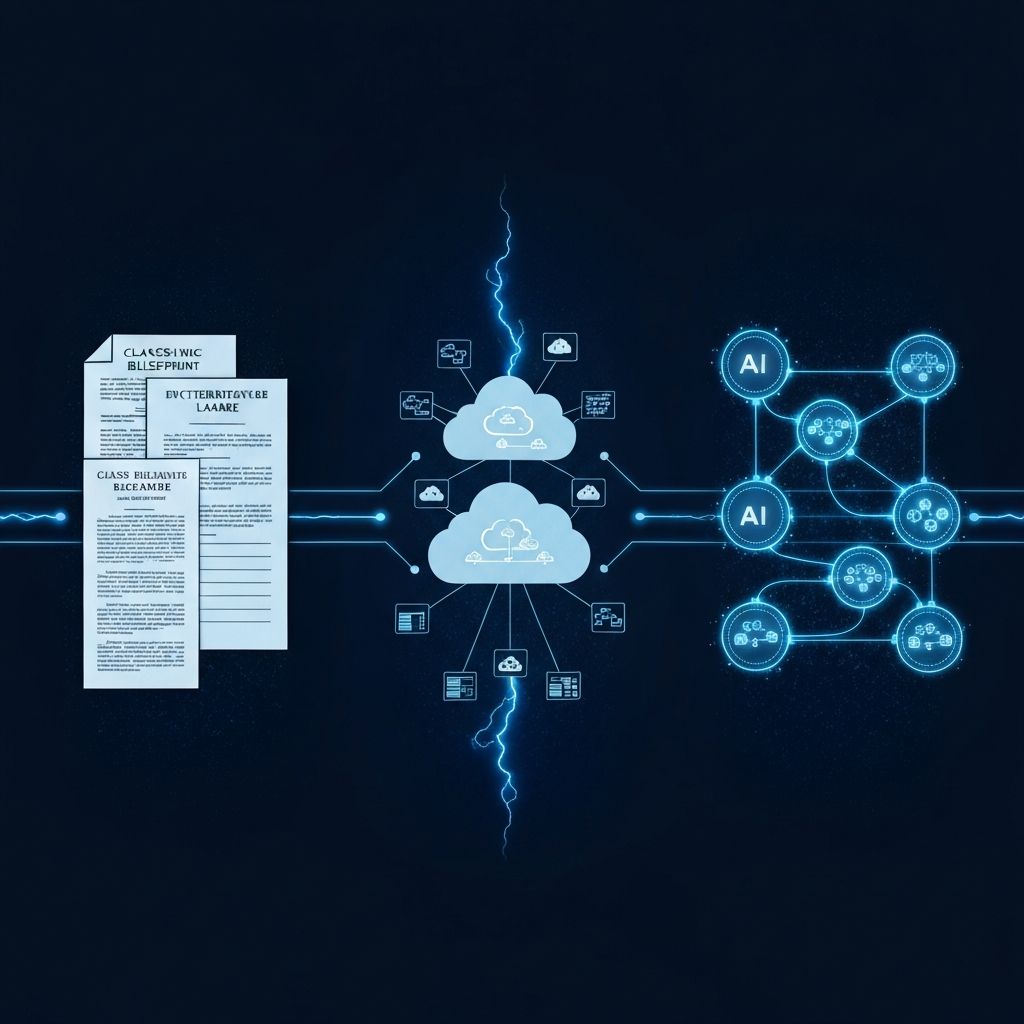
On the surface, GPT‑6 ASTRA looks like another model release. Beneath the surface, it is a business model event.
"GPT‑6 ASTRA changes the economics of knowledge work."
1. ASTRA Is a Business Model Event, Not Only a Model Launch
Every few years, a model release matters less for its benchmark scores and more for what it makes economically possible. ASTRA belongs to that category. Its relevant capability is not that it writes better prose or answers questions more accurately. It is that frontier AI is moving closer to execution — navigating applications, operating across multiple steps, and producing professional-grade deliverables with materially less human coordination.
That shift changes what AI can be asked to own inside an enterprise, and therefore changes the economics of the work it touches.
2. The Economics of Knowledge Work Are Changing
Knowledge work has historically been priced and organized around scarce human coordination: the analyst who assembles the data, the associate who drafts the memo, the operator who moves information between systems. As AI becomes capable of participating directly in that coordination — not just producing a draft, but executing a sequence of steps across tools — the cost structure underneath knowledge work begins to shift.
This does not mean expertise stops mattering. It means the leverage of expertise changes: the same senior judgment can be applied across a larger surface area of work, faster, if the surrounding execution is trustworthy.
3. Seven Sources of Potential Enterprise Value
- Shorter research and decision cycles
- Faster creation of professional deliverables
- Reduced friction between applications and workflows
- Greater access to institutional knowledge
- Expertise scaled without proportional headcount growth
- New products and services created more rapidly
- Operating models redesigned around intelligence
None of these are guaranteed outcomes. They are potential sources of value that depend entirely on how an organization connects the model's capability to its own processes, data, and accountability structures.
4. Why Access Will Not Create a Durable Advantage
"Access to intelligence is not the same as organizational readiness."
Frontier model access is becoming a commodity almost as quickly as it becomes available. Every competitor in a given industry will likely be able to license comparable capability within a similar window of time. That means the durable advantage cannot come from having the model — it has to come from what is built around it: the proprietary data connections, the process integration, the governance that lets an organization actually trust the model's output enough to act on it at scale.
5. The Model May Be Ready — The Enterprise May Not Be
A capability gap and a readiness gap are two different problems. The capability gap closes on OpenAI's release schedule. The readiness gap closes only when an organization has done the architectural work: defined what the model is allowed to touch, built the escalation paths for when it is uncertain, and established who is accountable when it acts.
"The more capable the model becomes, the more consequential its architecture becomes."
6. Seven Readiness Decisions Every Executive Team Must Make
- Which systems and data an AI agent may access, and under what conditions
- What level of autonomy is appropriate for which categories of decisions
- How outputs are validated before they reach a customer, regulator, or the market
- Who is accountable when an AI-executed action produces an unwanted outcome
- How employees are trained to supervise rather than simply consume AI output
- How vendor and model dependencies are governed over time
- How all of the above is documented so it can be audited, not just described
7. The New Role of Enterprise Architecture
Enterprise architecture has traditionally mapped how systems, data, and processes connect. In an agentic enterprise, it must also map how autonomous decision-making connects to human accountability — where an agent's authority begins and ends, and what evidence trail it leaves behind. This is a new architectural layer, not an extension of an old one.
8. From AI Experimentation to Governed Operations
Most organizations are still in an experimentation posture: pilots, proofs of concept, isolated use cases. ASTRA-class capability makes that posture increasingly risky, because the same capability that makes a pilot impressive is what makes an ungoverned deployment consequential. The organizations that move fastest safely will be the ones that treat governance as the mechanism that allows scale — not as a brake on it.
9. How ARCHAI WORLD™ Connects the Required Capabilities
We Built the Ecosystem Before the Model Made It Obvious.
ARCHAI WORLD™ is not a single-product AI company. From San Francisco, its specialized teams and innovation fronts work across enterprise AI, AI governance, enterprise architecture, executive intelligence, Professional Digital Twins, AI agents, education and human transformation.
The ecosystem connects:
ARCHAI Enterprise™ — Enterprise architecture, governance, intelligent operating models and transformation.
ARCHAI WORLD Studio™ — AI agents, workflows, operational tools and Mission Control.
ARCHAI WORLD University™ — Human, leadership and organizational capabilities for the Intelligence Age.
ARCHAI Marketplace™ — Agents, experts, frameworks, templates and enterprise solutions.
Professional Digital Twin™ — Professional knowledge, decision patterns, context and continuity.
ARCHAI Executive Intelligence OS™ — Signals, decision flows, evidence and executive oversight.
"Intelligence is no longer scarce. Architecture is."
The competitive advantage is not one model, one agent or one prompt. It is the architecture connecting intelligence, people, decisions and outcomes.
What Could Prevent Your Organization from Capturing ASTRA’s Value?
Complete the complimentary five-minute assessment and identify your organization’s three most important readiness gaps.
Get Your Readiness Score10. Assessing Your Organization’s Readiness
ASTRA expands what enterprises can execute. Architecture determines what they can scale. The gap between the two is where most of the near-term risk — and most of the near-term opportunity — will be found over the next 24 months.
The organizations that ask the readiness questions now, before capability outpaces governance, will be the ones positioned to capture ASTRA's value rather than absorb its risk.
ASTRA Expands What Enterprises Can Execute. Architecture Determines What They Can Scale.
GPT‑6 ASTRA capabilities referenced in this analysis are based on information published by OpenAI. AI Governance Today and ARCHAI WORLD™ are independent and are not affiliated with, sponsored by or endorsed by OpenAI. Read OpenAI's official announcement →
Leonardo Ramirez is the Founder and Chief Architect of ARCHAI WORLD™. He has 30 years of enterprise architecture experience across banking, healthcare, logistics, technology, and government — three continents, 45+ countries.
Filed under: Enterprise AI · AI Governance · Enterprise Architecture · AI Leadership