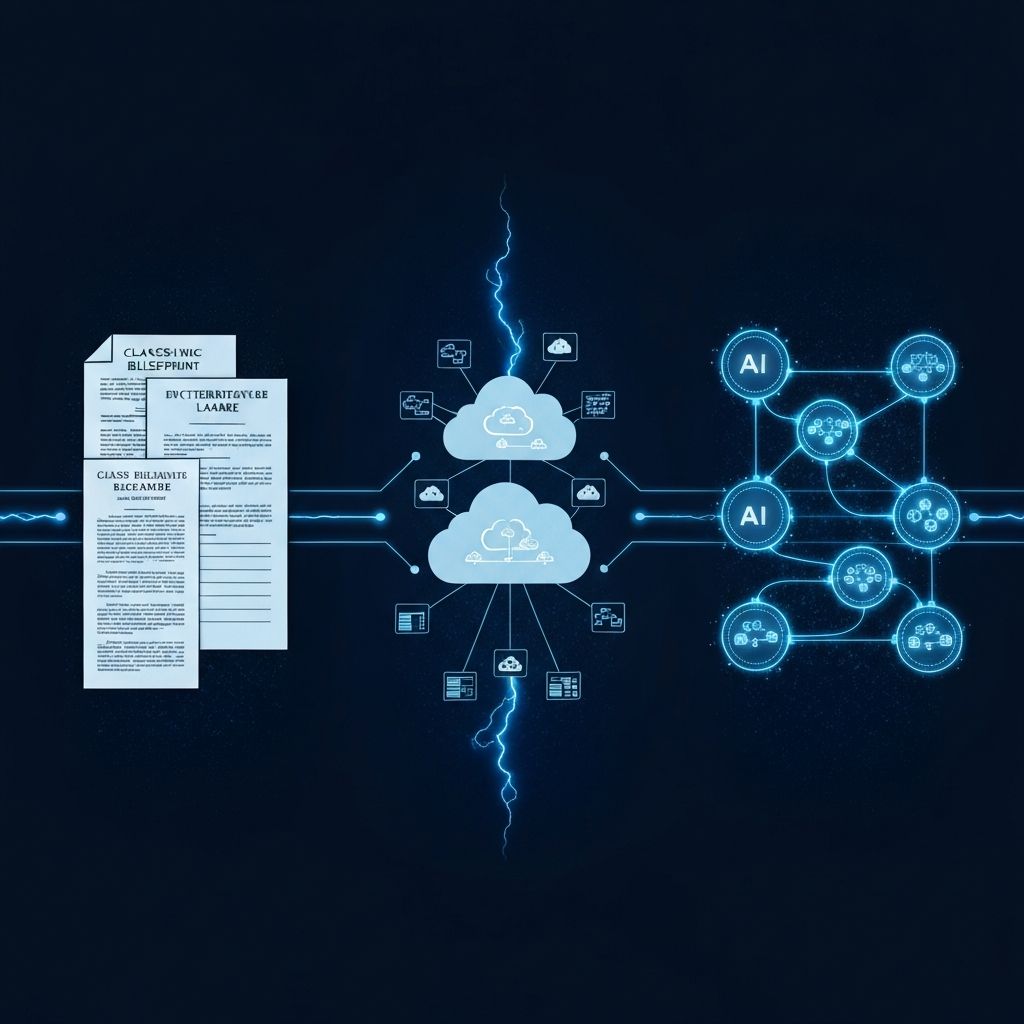
Inside the Marks & Spencer cyberattack: what happened, how the intrusion spread into business operations, what a FAIR risk analysis reveals, and how a connected enterprise architecture and AI governance strategy could reduce the next retailer’s exposure.
An AI Governance Today Special Investigation | November 8, 2026 | By AI Governance Today, Enterprise Risk & Architecture Investigation
The Incident: When the Stores Stayed Open but the Business Stopped Working
On April 22, 2025, British retail giant Marks & Spencer publicly acknowledged a cybersecurity incident. At first, the disruption appeared manageable. Stores remained open, while the company introduced operational restrictions to protect customers and systems.
Three days later, the situation had escalated. On April 25, M&S suspended online ordering across its UK and Ireland websites and apps, along with certain international operations.
What followed was not simply a website outage. Online shopping was interrupted. Click-and-collect operations were affected. Product availability deteriorated. Logistics and inventory processes experienced disruption. Staff were forced to operate parts of the business manually.
By May 13, the retailer confirmed that attackers had obtained some personal customer information, including potentially contact details, dates of birth, and order histories. The company said that usable payment-card details and account passwords had not been taken. The attack had moved from a technology incident to an enterprise-wide operational crisis.
A retailer does not have to close its physical stores to suffer a severe business interruption. It only has to lose confidence in the digital systems connecting customers, orders, inventory, logistics, and finance.
The financial consequences
In May 2025, M&S warned that the incident could reduce its 2025/26 operating profit by approximately £300 million before mitigation. Its subsequent financial results provided a more detailed picture. For the financial year ended March 28, 2026, M&S disclosed:
- £131.3 million in costs directly associated with the cyber incident.
- £109.3 million of that amount related to immediate systems response and recovery.
- £100 million in insurance proceeds associated with the incident.
- A substantial decline in Fashion, Home & Beauty profitability, influenced by disrupted online trading, inventory availability, and clearance activity.
These amounts measure different financial effects and should not simply be added together. The £300 million figure was an early estimate of operating-profit disruption before mitigation. The £131.3 million reflects directly identified incident-related costs. Insurance recoveries, lost operating contribution, and restructuring effects must be analyzed separately. The case nevertheless demonstrates how a cyberattack can become a material financial and strategic event.
And that raises the essential question: was this primarily a cybersecurity failure, or an enterprise architecture and risk-governance failure exposed by a cyberattack? The evidence suggests that the correct answer requires examining both.
Part I: Reconstructing the Attack
Entry point: the third-party trust boundary
On May 21, 2025, Reuters reported that M&S CEO Stuart Machin described attackers using social engineering against personnel working for a third-party contractor to gain access. Rather than overcoming every technical defense directly, the attackers reportedly exploited an organizational trust relationship.
That distinction matters. A business may invest heavily in perimeter defenses and still expose itself through contractor identities, service accounts, support workflows, or privileged remote access. A trusted supplier may have legitimate reasons to connect to enterprise systems. But legitimate connectivity is not equivalent to legitimate activity.
The specific identities, exact systems traversed, and full sequence of technical actions have not been publicly established in sufficient detail to reconstruct every stage conclusively. Therefore, the following sequence should be understood as an analytical attack-path model, not a forensic assertion about M&S.
Reconstructed risk pathway
- Social engineering. The attacker targets a trusted person or support process connected to the enterprise. Potential control failure: identity-verification procedures that can be manipulated.
- Trusted access. A compromised identity or access workflow allows the attacker to operate within an existing trust relationship. Potential control failure: insufficiently restrictive third-party or privileged access.
- Unauthorized internal activity. The attacker attempts to discover systems, credentials, and pathways that support enterprise operations. Potential control failure: weak isolation between critical environments or ineffective detection of identity misuse.
- Business-system exposure. Compromise or uncertainty about the integrity of connected services requires defensive containment. Potential control failure: highly interconnected business processes without sufficiently tested isolation or degraded operating modes.
- Business interruption. Online ordering, inventory flows, and operational services become unavailable or constrained. At this stage, the loss is no longer simply technical. It becomes financial, operational, commercial, and reputational.
What investigators have established
On July 10, 2025, the UK’s National Crime Agency announced four arrests related to its investigation of cyberattacks affecting M&S, Co-op, and Harrods. Arrests do not establish guilt, and public reporting should not treat the identities or precise roles of individual suspects as conclusively proven.
Equally important, there is no public evidence establishing that autonomous AI agents executed the M&S intrusion. AI-enabled impersonation, automated reconnaissance, and agentic attacks are relevant forward-looking scenarios, not confirmed components of this historical incident.
Part II: The Six Enterprise Failures Every Board Should Investigate
The M&S case does not prove that each control below was absent. These are the six risk questions the incident makes unavoidable for large, interconnected organizations.
1. Third-party identity and privileged access
Who can access critical systems through suppliers, contractors, and outsourced support providers? Critical controls include phishing-resistant multifactor authentication, independently verified administrative changes, just-in-time privileges, monitored support sessions, and immediate access revocation.
2. Enterprise dependency visibility
Can the organization trace how an identity or service compromise might affect ordering, inventory, payments, customer information, and financial reporting? A technical asset inventory is insufficient if it cannot explain business consequences.
3. Segmentation and blast-radius containment
Can a compromised contractor identity reach multiple business-critical environments? Organizations should test whether high-value services remain isolated when a trusted user, provider, or integration is compromised.
4. Operational resilience
Can the business continue accepting orders, managing inventory, fulfilling deliveries, and protecting financial records under reduced technology availability? Backup restoration is one requirement. Continuity of commercial operations is another.
5. Decision and governance accountability
Who has authority to approve privileged access, disconnect systems, invoke crisis procedures, and restore operations? What evidence supports those decisions? When an incident crosses technology, operations, finance, legal, and customer service, unclear decision rights can amplify its consequences.
6. AI and agent governance
Where AI agents are used in IT support, customer operations, security operations, or financial workflows, what prevents them from accepting fraudulent instructions or misusing legitimate tool permissions? This is a new risk layer, not a claim about the cause of the M&S breach. Modern enterprise architecture must account for both human and machine identities.
Part III: Applying FAIR: Putting a Price on Enterprise Cyber Risk
Traditional risk reports frequently classify scenarios as red, amber, or green. Executives, however, must decide how much capital to allocate, which controls to prioritize, and what residual loss they are prepared to accept. The Factor Analysis of Information Risk (FAIR) model provides a quantitative framework that considers the probable frequency and magnitude of loss. A simplified expression is:
Annualized expected loss = loss-event frequency × expected loss magnitude
Loss-event frequency = threat-event frequency × susceptibility
In FAIR terminology, susceptibility relates to the probability that an attempted threat event produces a loss event under the scenario being analyzed.
Defining the risk scenario
- Asset: a large omnichannel retailer’s critical ordering, fulfillment, inventory, and supporting enterprise services.
- Threat community: criminal actors seeking access through trusted external support relationships.
- Threat event: a social-engineering attempt that results in unauthorized privileged access.
- Loss event: the attacker gains sufficient access to trigger material disruption or compromise of critical business operations.
- Potential loss forms: response expenses, recovery costs, lost operating contribution, customer remediation, external professional services, legal exposure, and reputational consequences.
Illustrative FAIR analysis
The following figures are explicitly hypothetical. They are not estimates of M&S’s historical security controls, actual attack probability, or FAIR results independently validated against the company’s internal data.
| FAIR factor | Illustrative baseline |
|---|---|
| Material threat-event frequency | 0.60 per year |
| Susceptibility to material loss | 10% |
| Annual loss-event frequency | 0.060 |
| Conditional mean loss magnitude | £35 million |
| Expected annualized loss | £2.10 million |
The calculation is: 0.60 × 0.10 × £35 million = £2.10 million per year. The low annualized expectation does not mean a severe event cannot occur. It means that high-impact incidents can dominate an organization’s loss exposure even when they are relatively infrequent. A proper FAIR assessment would use distributions, uncertainty ranges, and sensitivity testing rather than relying on a single point estimate.
Modeling a treatment scenario
Suppose an enterprise implements and validates a coordinated security and resilience program that reduces the probability of successful compromise, restricts lateral access and privileged actions, improves detection, isolation, and response, reduces outage duration and recovery costs, and establishes tested alternative operating procedures. For illustration, assume the frequency of attempts remains unchanged, susceptibility declines to 3.5%, and mean loss magnitude falls to £18 million.
| FAIR factor | Baseline | Modeled treatment |
|---|---|---|
| Threat-event frequency | 0.60 | 0.60 |
| Susceptibility | 10% | 3.5% |
| Loss-event frequency | 0.060 | 0.021 |
| Mean loss magnitude | £35m | £18m |
| Expected annualized loss | £2.10m | £0.378m |
Illustrative expected annual risk reduction: £1.722 million, or approximately 82%. That percentage is a model output under the stated assumptions, not a demonstrated performance claim for ARCHAI WORLD or any particular security product. A company evaluating a proposed investment must compare the estimated loss reduction with implementation cost, recurring expense, control effectiveness, uncertainty, and business constraints.
What data would be needed to validate this model?
Actual third-party access inventories, historical social-engineering attempts, identity-compromise events, privileged-session logs, control test results, business interruption scenarios, financial contribution by channel, recovery timelines, and cyber insurance details. Without those inputs, a numerical model is a decision-making illustration, not a defensible company-specific risk forecast.
Part IV: What Could Have Reduced the Damage?
There is no evidence that one product, control, or architecture framework could have prevented this incident with certainty. The appropriate question is which combinations of controls could have reduced the likelihood of a successful intrusion, limited its spread, or reduced the eventual business impact. A credible defensive response has multiple layers.
- Before compromise: strengthen supplier identity verification, authentication, least privilege, and separation of duties.
- During unauthorized activity: detect anomalous administrative behavior, monitor privileged sessions, revoke compromised identities, and isolate critical systems.
- During containment: preserve trustworthy recovery paths and protect high-value information and business processes.
- During business disruption: switch to tested fallback operating procedures, maintain financial integrity, and prioritize restoration by business impact.
- After recovery: quantify losses, examine control failures, improve the architecture, and revalidate resilience with evidence.
This is where a connected enterprise-risk model becomes especially relevant.
Part V: The ARCHAI WORLD Counterfactual: How the Portfolio Could Be Applied
The following is a proposed response architecture for an organization facing a similar threat. It is not a description of products deployed by M&S or a claim that any ARCHAI WORLD offering would have prevented the historical incident.
ARCHAI 360°: Find the exposures before a breach
Begin with an executive exposure assessment across 17 interconnected risk domains. For a retail business, the assessment should prioritize contractor access, critical business services, supplier dependencies, digital identities, operational continuity, AI integrations, and customer-data exposure.
Deliverable: an evidence-informed executive risk register, initial exposure map, and prioritized action plan. This is an assessment and prioritization activity, not a substitute for full forensic testing or penetration testing.
Explore ARCHAI 360° (archaiworld.com/360-exposure)
ARCHAI SHIELD™: Connect security to business decisions
Apply the ARCHAI SHIELD concept to create a structured view of how identities, AI agents, enterprise connections, authorizations, and critical business decisions affect risk. In this scenario, SHIELD would be positioned to support the governance and evaluation of questions such as: can a third-party account authorize a sensitive change? Can a service identity invoke critical operations outside its approved context? What evidence should exist before a high-impact action proceeds?
Objective: reduce blind spots between cybersecurity controls and business decision-making. Any continuous enforcement, detection, or blocking capability would need to be verified in the customer’s actual technical environment rather than assumed.
Explore ARCHAI SHIELD (archaiworld.com/shield)
Enterprise Context MCP™: Make dependencies understandable
Use enterprise architecture, documented services, process models, approved contextual data, and reference frameworks to support AI-assisted analysis. A retail business could use this context to ask: if the identity-management service fails, which customer-facing processes are affected? Which fulfillment capabilities depend on the same supplier integration? Which services need to be recovered first to restore revenue and customer trust?
Objective: improve the quality of architectural and operational decisions using trustworthy, governed enterprise context.
Explore Enterprise Context MCP (archaiworldstudio.com/enterprise-context-mcp/docs)
ARCHAI MIRAGE™: Evaluate defensive deception opportunities
Consider defensive deception as an additional control layer in an appropriately governed architecture. For example, monitored decoy credentials or nonproduction assets may help reveal suspicious behavior. These mechanisms must be designed, implemented, and tested by qualified security teams.
Objective: explore earlier detection and stronger visibility into unauthorized activity.
Explore ARCHAI MIRAGE (archaiworld.com/archai-mirage)
ARCHAI WORLD Studio: Test real decisions
Create practical simulation missions around supplier impersonation, privileged access, ransomware response, and restoration of critical retail services. Rather than asking employees to memorize policy documents, evaluate their ability to act under realistic operating constraints.
Objective: translate theoretical controls into observable professional and organizational capabilities.
Explore ARCHAI WORLD Studio (archaiworldstudio.com)
ARCHAI WORLD University: Build the human capability
Train architects, cybersecurity leaders, technology executives, risk professionals, and operational teams together. Relevant areas include Enterprise Architecture with AI, AI Governance, cybersecurity, sustainability, executive resilience, and the Chief AI Hacking Officer program. For organizations, the Corporate Unlimited membership model provides a route to develop shared capabilities across teams rather than training isolated individuals.
Objective: break down the organizational silos that allow technology problems to become unmanaged business crises.
Explore ARCHAI WORLD University (archaiworld.university)
Part VI: A 90-Day Executive Response Model
A business with similar exposure could organize its initial program around three phases.
Days 1–30: Establish the truth
- Identify critical business services, supplier access paths, privileged identities, critical data flows, and high-impact dependencies.
- Perform an executive exposure assessment.
- Define three to five material FAIR loss scenarios and gather the information needed to estimate them.
- Confirm response ownership among the CIO, CISO, COO, CFO, and business-unit executives.
Days 31–60: Reduce the most consequential exposures
- Apply strengthened identity verification and privileged access controls.
- Review access inherited from contractors and suppliers.
- Reduce unnecessary connectivity between business-critical environments.
- Improve monitoring of administrative activity and high-impact changes.
- Validate backup integrity, recovery dependencies, and continuity procedures.
- Conduct practical exercises with business and technology leaders.
Days 61–90: Demonstrate resilience
- Run a realistic simulated supplier-identity compromise.
- Test isolation of critical systems and restoration of priority business services.
- Quantify the plausible effect of improvements on loss-event frequency and loss magnitude.
- Present residual risk, required investment, and decision options to the board.
The final output should not be another presentation declaring the enterprise secure. It should be a documented demonstration of which business services can withstand disruption, which decisions are controlled, and which risks remain.
Part VII: The Boardroom Questions That Matter
The Marks & Spencer incident should force boards to reconsider what they ask about cybersecurity.
- Instead of asking only, “Are we compliant?” ask: which business capabilities could we lose if a trusted supplier identity were compromised?
- Instead of asking, “Do we have backups?” ask: how much revenue and operating profit would we lose while recovering our most critical services?
- Instead of asking, “Are we using AI?” ask: which AI agents and automated services can access sensitive systems, and who governs their decisions?
- Instead of asking, “How much are we spending on security?” ask: how much financial exposure are our controls demonstrably reducing?
These are questions that connect cybersecurity, enterprise architecture, AI governance, operational resilience, and executive accountability.
The Final Finding
The public record establishes that Marks & Spencer suffered a major cyber incident that disrupted business operations, exposed some customer information, triggered extensive recovery work, and produced substantial financial consequences. It does not establish that every architectural weakness discussed in this report was present at M&S.
But it establishes something equally important. A trusted access relationship can become an enterprise-wide business risk when identity, technology, operations, suppliers, and critical services are deeply interconnected.
Cybersecurity cannot be reduced to a firewall. Enterprise Architecture cannot be reduced to diagrams. AI Governance cannot be reduced to policies. And resilience cannot be measured by the existence of backups alone.
The next major incident may begin with a supplier account, a support request, a compromised identity, or an AI agent acting with inappropriate permissions. What matters is whether the organization can understand, control, contain, and recover from that event.
The attack may begin in IT. But the losses will appear in the business.
That is why security must be architected, governed, tested, and quantified.
Protect people. Govern AI. Secure decisions.
ARCHAI WORLD: Enterprise Architecture, AI Governance, Cyber Risk & Executive Transformation. archaiworld.com
Source Notes and Methodology
This report is based on corporate disclosures, regulatory announcements, law-enforcement statements, contemporaneous Reuters reporting, and FAIR Institute methodology. It distinguishes documented facts, externally reported investigative findings, analytical inferences, and hypothetical financial modeling.
- Marks & Spencer, Cyber Incident Update, April 22, 2025. data.fca.org.uk
- Marks & Spencer, Cyber Incident Further Update, April 25, 2025. data.fca.org.uk
- Marks & Spencer, Customer Data Disclosure, May 13, 2025. data.fca.org.uk
- Marks & Spencer, Full Year Results, May 2025. corporate.marksandspencer.com
- Marks & Spencer, Full Year Results, May 2026. corporate.marksandspencer.com
- Reuters, May 21, 2025, reporting the third-party social-engineering account attributed to M&S management.
- UK National Crime Agency, July 10, 2025, investigation and arrests connected to retail-sector cyberattacks. nationalcrimeagency.gov.uk
- FAIR Institute, Risk, Threat Event Frequency, Vulnerability and Loss Magnitude methodology. fairinstitute.org
Editorial disclosure: ARCHAI WORLD solutions are included as a proposed counterfactual risk-management architecture and represent a commercial perspective. No independent test of those solutions against the M&S incident is claimed. FAIR numerical examples are hypothetical and should not be interpreted as forecasts of losses or guaranteed benefits.