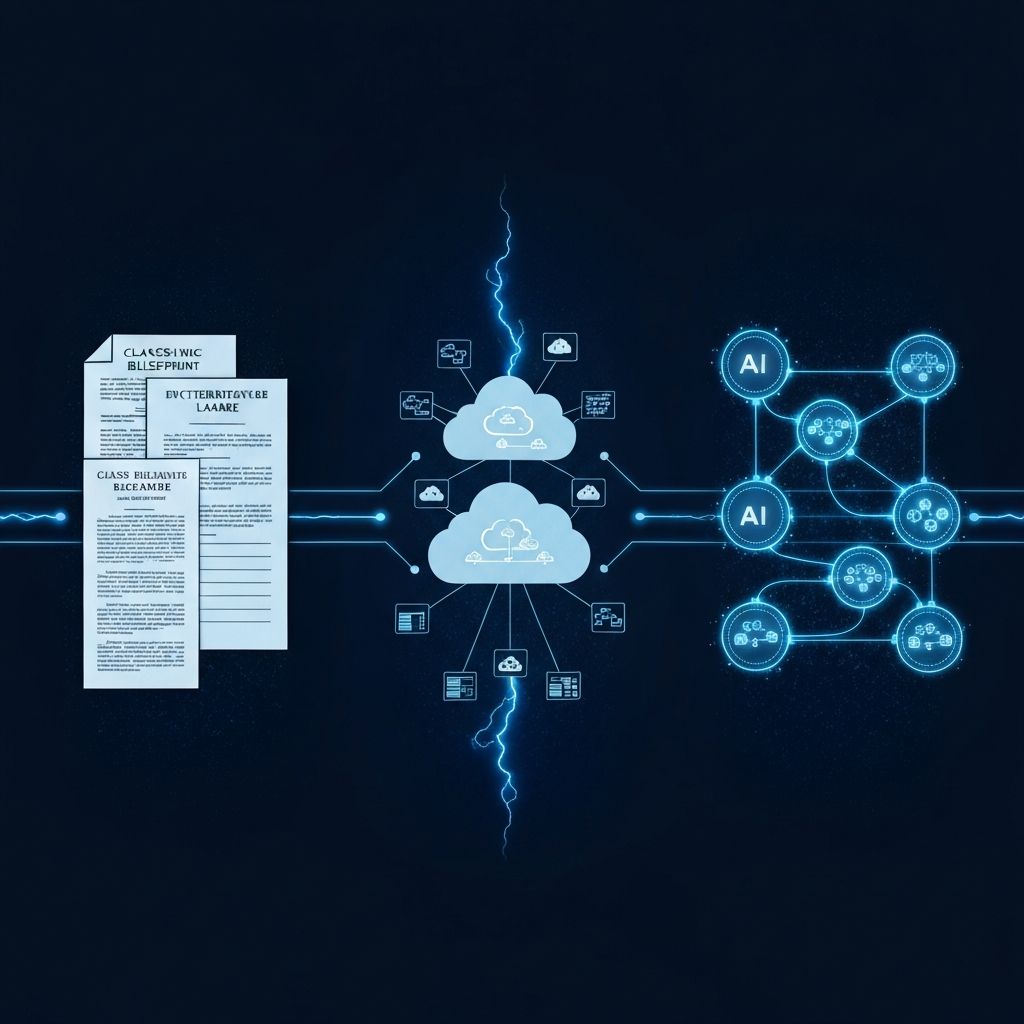
For thirty years, enterprise architecture has operated on a stable set of assumptions: systems are designed by humans, operated by humans, and governed by policies written for human behavior. Agentic AI — autonomous systems capable of reasoning, planning, and taking consequential actions across enterprise environments — has invalidated every one of those assumptions simultaneously.
The challenge facing enterprise architects in 2026 is not simply integrating a new type of technology. It is redesigning the fundamental architecture of the enterprise for a world in which non-human agents act on behalf of the organization — accessing data, triggering workflows, negotiating with external systems, and making decisions that carry real business and legal consequences.
What Agentic AI Actually Means for Enterprise Architecture
Agentic AI systems are distinguished from previous generations of enterprise AI by four characteristics: autonomy (they pursue goals without requiring step-by-step human direction), tool use (they can invoke APIs, query databases, execute code, and interact with external systems), multi-step reasoning (they can decompose complex problems into sequences of actions), and adaptation (they can modify their approach based on intermediate results and environmental feedback).
These characteristics, individually, are not new to enterprise systems. What is new is their combination in systems that are increasingly being given consequential authority — the ability to initiate financial transactions, communicate with customers, modify records, and take actions that create legal obligations. The enterprise architecture community has no established playbook for this.
"Every EA framework I have worked with assumes that the entity making decisions is a human being with legal standing, organizational accountability, and cognitive judgment," notes Ramírez, who has been developing what he calls the Agentic Enterprise Architecture (AEA) framework since early 2025. "When the entity making decisions is an AI agent, all of those assumptions collapse simultaneously. We need a new architectural vocabulary."
The Five Architectural Domains Requiring Redesign
1. Identity and Authorization Architecture. Traditional IAM (Identity and Access Management) systems are designed for human identities — users with persistent credentials, role-based permissions, and audit trails of human actions. Agentic AI systems require what Ramírez calls "Dynamic Agent Authorization" (DAA): identity frameworks where agents are granted contextual, time-bounded, scope-limited permissions rather than persistent access. An agent authorized to process a specific customer inquiry should not retain that authorization after the inquiry is resolved. An agent authorized to read financial data should not have write access unless explicitly granted for a specific, logged purpose.
2. Data Architecture and Governance. Agentic systems interact with enterprise data in fundamentally different patterns than human users. They access data at machine speed, across multiple systems simultaneously, following algorithmic patterns that may not map to any human workflow. This creates both capability — agents can synthesize information across systems in ways humans cannot — and risk, as agents may combine data from disparate sources in ways that create privacy, regulatory, or competitive exposure. Data architecture for agentic AI requires granular, context-aware data access controls, comprehensive agent action logging, and automated detection of anomalous data access patterns.
3. Workflow and Process Architecture. Enterprise workflows have historically been designed for predictable, deterministic execution — if condition A, then action B, else action C. Agentic systems introduce probabilistic, adaptive execution into workflow environments. This is powerful — agents can handle exceptions and edge cases that would stall deterministic workflows — but it requires architectural support for explainability (why did the agent take this path?), auditability (what did the agent do, in what sequence, and why?), and human override (at what points can humans intervene to redirect or halt agent execution?).
4. Security Architecture. The enterprise security perimeter was already under strain from cloud migration and remote work. Agentic AI blows it open entirely. Agents may operate across internal and external systems, may communicate with other AI systems (including competitor systems), and may be targeted by adversarial prompts designed to manipulate their behavior. The emerging discipline of "agentic security" addresses prompt injection attacks, agent-to-agent trust verification, and containment architectures that limit the blast radius of a compromised agent.
5. Governance and Accountability Architecture. When an AI agent takes a consequential action — sends a legally binding communication, initiates a financial transaction, modifies a customer record — who is responsible? The answer must be a human being (or legal entity) with standing to accept that responsibility. Enterprise architecture must define clear accountability chains for agent actions: the business owner of the agent system, the process owner of the workflow the agent was executing, and the governance body responsible for the agent's authorization scope.
The AEA Reference Architecture
Based on implementations at scale in financial services and healthcare, Ramírez's AEA framework proposes a layered architecture organized around five zones:
The Agent Fabric Layer — infrastructure for agent deployment, orchestration, monitoring, and lifecycle management. This is the operational backbone of the agentic enterprise.
The Authorization and Trust Layer — dynamic IAM, context-aware permissions, agent identity management, and cross-system trust protocols.
The Cognitive Services Layer — AI model infrastructure, tool libraries, knowledge bases, and the interfaces through which agents access enterprise intelligence.
The Governance and Audit Layer — comprehensive logging of agent actions, real-time monitoring dashboards, anomaly detection, and the interfaces through which humans oversee and can intervene in agent operations.
The Business Process Layer — the enterprise workflows, data systems, and external integrations through which agents create business value. This layer is not redesigned for agentic AI; rather, it is equipped with the governance and authorization infrastructure that allows agents to operate within it safely.
Implications for the EA Profession
The emergence of agentic AI is not merely a technical challenge for enterprise architects — it is a professional identity challenge. The enterprise architect who understood their role as designing systems for human users is being asked to redesign enterprises for a mixed human-AI workforce in which the boundaries of human and machine agency are continuously shifting.
This demands new competencies: understanding of AI reasoning patterns and failure modes, familiarity with AI governance frameworks including ISO 42001, ability to model probabilistic and adaptive processes alongside deterministic ones, and the organizational credibility to guide executive decision-making about AI authority and accountability.
The organizations that will thrive in the agentic era are those that treat enterprise architecture not as a technical function but as a strategic governance capability — and that invest in building EA teams with the breadth of expertise to navigate this transformation. The blueprint exists. The urgency is real.